Rankify: SEO Performance & Operations Platform
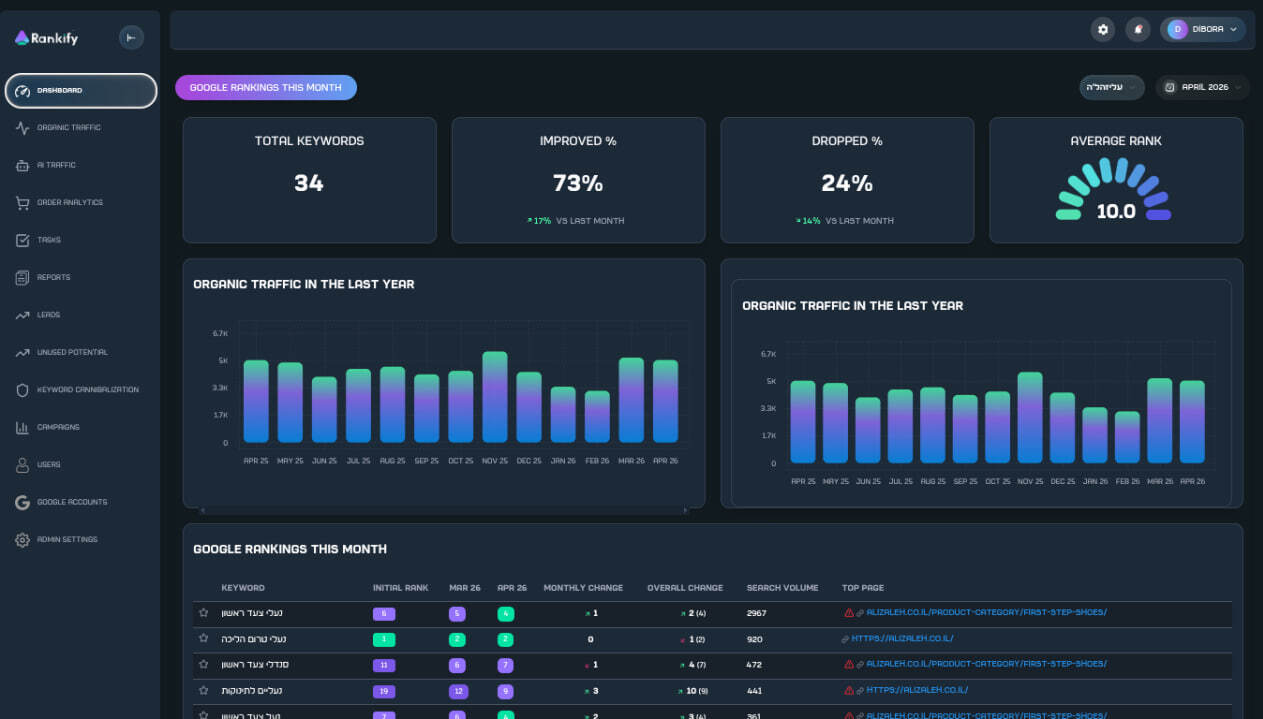
A multi-tenant SEO operations suite that centralizes Search Console rankings, GA4 insights (including AI-referral traffic), WordPress lead capture, and a task/reporting workflow—so teams can execute consistently and report without spreadsheets.
Overview
Rankify is an SEO performance and operations platform built for teams managing organic growth across multiple client websites (campaigns). It consolidates the operational SEO stack—rankings, traffic, leads, tasks, reporting, and AI-assisted planning—into one dashboard.
Instead of manually pulling GSC exports, GA4 reports, WordPress form entries, and monthly decks, Rankify turns SEO into an execution system: measure → prioritize → ship → report.
What it enables
- A single source of truth for keyword and traffic performance across campaigns.
- Fast, predictable dashboards powered by scheduled precomputation.
- Operational tooling (tasks + reports) tied to real performance data.
- Visibility into emerging discovery channels like AI referral traffic.
Key features
Campaign management (multi-tenant)
- Admins can create/manage campaigns, connect Google accounts, store tracked keyword sets, and control member access.
SEO analytics dashboard (GSC + precomputed KPIs)
- Keyword rankings over time, impressions/clicks, top queries, and traffic trends.
- Keyword cannibalization detection (multiple pages competing for the same query).
- Unused Potential metrics calculated monthly and stored in computed KPI tables to keep the UI fast.
AI traffic analytics (GA4)
- Detects traffic referred by AI tools (ChatGPT, Claude, Gemini, Perplexity, etc.) via GA4 Data API filtering.
- Breakdowns by campaign and time period for quick “is AI discovery moving?” answers.
Content planning workflow (AI-assisted)
- Keyword analysis pulls top SERP pages, extracts content signals, and generates structured briefs: headline ideas, section outlines, word count targets, and keyword placement guidance.
- Brand profile + tone analysis keeps generated briefs consistent with a client’s voice.
Leads pipeline + notifications (WordPress)
- Ingests organic leads through a WordPress webhook.
- Performs signature/campaign matching + deduplication for data hygiene.
- Sends Slack notifications so leads are actionable immediately.
Task board + delivery workflow
- Per-campaign kanban board with tasks, members, attachments, comments, and checklists.
- Monthly reporting with database-backed report items, draft → publish flow, and public sharing.
WordPress order analytics integration
- Pulls order analytics snapshots from a secured WordPress endpoint.
- Uses scheduled caching so the dashboard renders from stored snapshots rather than live calls.
Architecture
Rankify is organized as a typed, integration-heavy SaaS with scheduled background automation:
-
Frontend (Next.js + TypeScript) App-router dashboards (campaigns, leads, AI traffic, cannibalization, unused potential, reports, tasks). Calls the backend through a typed tRPC client.
-
Backend (Express + tRPC) tRPC for core application procedures, OAuth routes for Google account connection, and webhooks for WordPress ingestion. Background jobs handle external pulls and monthly precomputations.
-
Database (MySQL via Prisma) Prisma models for users, campaigns, Google accounts, daily keyword stats, monthly computed tables, leads, tasks, reports, and AI/content planning records.
Portfolio-worthy implementation details
Precomputation for performance
A dedicated monthly-computed table (e.g. SearchConsoleKeywordMonthlyComputed) plus a cron-driven precompute job keeps analytics queries fast and predictable at UI time.
Robust scheduled automation
A central Cron service orchestrates multiple jobs (keyword stats, cannibalization audits, unused potential, AI traffic, WordPress order cache) with status tracking for observability.
GA4 property auto-discovery
Campaigns are matched to GA4 properties using a scoring heuristic (website URL + display name), reducing setup friction and support burden.
Webhook security + hygiene
Signature verification, campaign/domain association, paid-UTM filtering, and short-window deduplication prevent noisy or duplicate lead ingestion.
Typed API boundary
End-to-end types shared through tRPC reduce API drift and speed up feature delivery.
Tech stack
- Frontend Next.js, TypeScript, tRPC, React Query, Tailwind CSS, Radix UI, Recharts, Redux Toolkit.
- Backend Node.js, TypeScript, Express, tRPC, Prisma, node-cron.
- Integrations Google Search Console, Google OAuth2, GA4 Admin + Data API, WordPress webhooks/endpoints, Slack Bot API, and AI tooling for analysis + briefing.