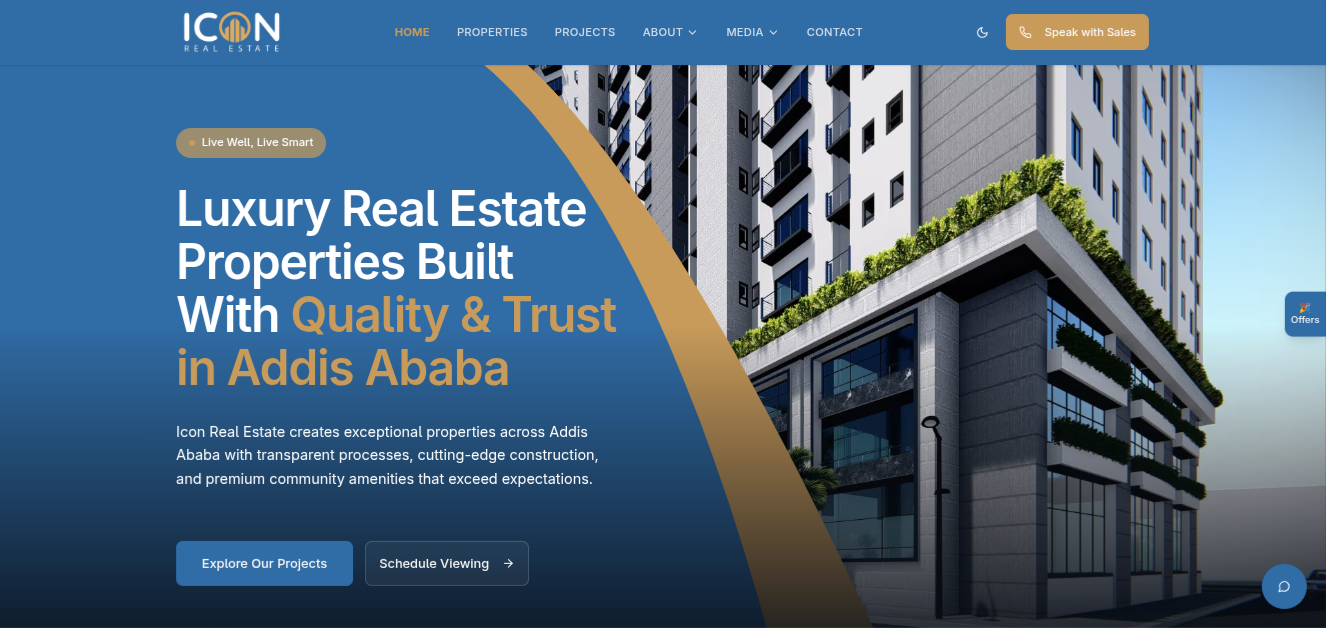
Icon Real Estate Platform
A full-stack real estate platform for Addis Ababa, combining a modern Next.js frontend with a robust Laravel API backend. Features property showcases, dynamic content, and advanced administration.
Visit websiteOverview
Icon Real Estate is a full-stack real estate platform for Addis Ababa, Ethiopia, combining a modern Next.js frontend with a robust Laravel API backend. The platform enables the company to showcase premium properties, manage projects, publish content, and handle customer inquiries through a sophisticated admin dashboard—all while delivering an exceptional user experience with enterprise-grade SEO optimization.
Problem Solved: Traditional real estate websites lack the flexibility to manage complex property portfolios, project updates, and customer relationships efficiently. This platform provides a complete digital ecosystem for luxury real estate operations with transparent pricing, modern architecture, and premium community features.
Key Features
User-Facing Features
- Property & Project Showcase – Browse luxury properties and flagship projects with advanced filtering (type, status, location, price range)
- Dynamic Content Management – Blog posts, project progress updates, and company news with rich media support
- Inquiry System – Multi-channel contact forms with appointment scheduling and threaded conversations
- SEO-Optimized Pages – Structured data, dynamic sitemaps, Open Graph tags, and Twitter cards for maximum visibility
- Progressive Web App (PWA) – Offline support, installable app experience, and service worker caching
- Responsive Design – Mobile-first approach with Tailwind CSS following a strict 60-30-10 color distribution rule
- Multi-Media Support – Image galleries, YouTube integration, interactive maps, and optimized WebP conversions
Admin Dashboard Features
- Content Management – Full CRUD operations for properties, projects, blog posts, team members, and locations
- Media Library – Spatie Media Library integration with automatic image optimization and multiple collections
- Inquiry Management – Track customer inquiries, appointments, and threaded communications
- Role-Based Access Control – Spatie Permission package with granular permissions (Admin, Agent, Client roles)
- Analytics Dashboard – Real-time statistics, recent activities, and performance metrics
- Rich Text Editor – TipTap WYSIWYG editor for blog content with inline image uploads
- Project Progress Tracking – Timeline updates with media attachments for construction milestones
Architecture
Frontend (Next.js)
- App Router with server components for optimal performance
- Server Actions for mutations (create, update, delete operations)
- NextAuth.js for authentication with JWT strategy
- Axios for API communication with centralized error handling
- Shadcn/ui + Radix UI for accessible component primitives
- Tailwind CSS 4 with custom design tokens and strict style guidelines
Backend (Laravel)
- Modular Architecture – Domain-driven design with Auth, People, Enquiries, Leads, and Settings modules
- RESTful API – Versioned endpoints (
/api/v1/) with RFC 7807 error responses - Sanctum Authentication – Token-based API authentication with role/permission checks
- Spatie Packages – Query Builder, Media Library, Activity Log, Permissions, Response Cache
- OpenAPI Documentation – Auto-generated Swagger UI with L5-Swagger
- Docker Deployment – Multi-container setup with PHP-FPM, Nginx, MySQL, and Redis
Notable Implementations
1. Hydration-Safe Architecture
Strict separation of server/client components with icon mapping utilities to prevent React hydration errors. All data functions return plain objects, never React components.
2. Advanced SEO Strategy
- Dynamic metadata generation from company profile API
- Structured data (JSON-LD) for RealEstateAgent schema
- Automatic sitemap generation with priority/frequency
- Open Graph and Twitter Card optimization
- Canonical URLs and alternate language tags
3. Media Optimization Pipeline
Automatic image conversions (thumb, large, WebP) with Spatie Media Library. Multiple collections per model (featured_image, gallery, plans) with lazy loading and responsive srcsets.
4. Modular Backend Design
Domain-driven modules (Auth, People, Enquiries) with clear separation:
- Domain Layer: Models, business logic
- Interfaces Layer: Controllers, Requests, Resources, Routes
- Shared Layer: Enums, exceptions, utilities
5. Role-Based Access Control
Spatie Permission integration with predefined roles (Admin, Agent, Client) and granular permissions. Middleware guards on both frontend routes and backend API endpoints.
Tech Stack
- Frontend: Next.js 16 (React 19, TypeScript), Tailwind CSS 4, Shadcn/ui
- Backend: Laravel 12 (PHP 8.3)
- Database: MySQL 8
- DevOps: Docker, GitHub Actions, Vercel/Static Hosting